
BRITISH PERFIDY
A Small Island Nation

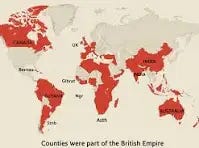
They say the sun never set on the British Empire. How a small island nation captivated the whole planet is mind-boggling. What is true is that the British Empire helped standardize and spread certain systems that still shape the world today—sometimes beneficially, often problematically, and usually both at once.
1. Language as Power: The Rise of English
The global dominance of English—whether in business, aviation, science, or the internet—owes a lot to British colonial expansion, later reinforced by American influence. Countries as diverse as India, Nigeria, and Singapore still use English as an official or working language.
This creates opportunity (shared communication) but also hierarchy—access to power often depends on fluency in a colonial language.
2. Legal and Political Frameworks
Many former colonies still operate on variants of British legal systems—common law, parliamentary democracy, and civil services. The idea of a “neutral bureaucracy” and codified law was exported widely.
Institutions like the Commonwealth of Nations are remnants of that structure, maintaining soft ties between former colonies.
But these systems weren’t always organically suited to local cultures—they were often imposed, sometimes clashing with indigenous governance traditions.
3. Economic Patterns: Extraction to Globalization
Colonial economies were designed for extraction—raw materials flowing out, finished goods flowing in. That pattern echoes today in global trade imbalances.
The roots of modern global capitalism—trade routes, shipping networks, and financial centers like London—were heavily shaped during colonial times. The Industrial Revolution in Britain depended significantly on colonial resources and markets.
4. Borders and Conflict
Many modern geopolitical tensions stem from borders drawn during colonial rule with little regard for ethnic or cultural realities.
Think of the Partition of India, the parting kick—a direct legacy of British withdrawal that still shapes politics in South Asia. Similar patterns exist in parts of Africa and the Middle East.
5. Cultural Hybridity
Colonialism didn’t just impose—it also blended. Food, language, architecture, and identity became hybrid.
From Indian railways (a colonial infrastructure still vital today) to cricket culture across former colonies, these are living legacies—neither wholly foreign nor purely indigenous.
6. Education and Elite Formation
Western-style education systems created local elites trained in British thought, law, and administration. Ironically, many leaders of independence movements—including figures like Mahatma Gandhi—were shaped by those same systems.
This legacy continues in how knowledge, “prestige education,” and intellectual frameworks are globally valued.
I quote William Dalrymple, the acclaimed historian and author of The Anarchy: ‘One of the very first words to enter the English language was the Hindustani word for plunder: ‘loot.’
“According to the Oxford English Dictionary, this word was rarely heard outside the plains of North India until the late eighteenth century, when it suddenly became a common term across Britain. To understand how and why it took root and flourished in so distant a landscape, one needs to only visit Powis Castle in the Welsh Marches.
Powis is simply awash with loot from India, room after room of imperial plunder, extracted by the East India Company (EIC) in the eighteenth century. There are more Mughal artifacts stacked in this private house in the Welsh countryside than there are on display in any one place in India—even the National Museum of Delhi.”
Dalrymple invites our attention to a huge framed canvas that hangs in the shadows over a doorway in a wooden chamber at the top of a dark oak-panelled staircase. It is not a masterpiece, he says, but it does repay close study: An effete Indian prince, wearing cloth of gold, sits high on his throne under a silken canopy. On his left stand scimitar-and-spear-carrying officers from his own army; to his right, a group of powdered and periwigged Georgian gentlemen stand. The prince is eagerly thrusting a scroll into the hands of a slightly overweight Englishman in a red frock coat.

The famous painting depicting Mughal Emperor Shah Alam II handing the Diwani rights to Lord Robert Clive is titled Shah 'Alam, Mughal Emperor (1759–1806), Conveying the Grant of the Diwani to Lord Clive, August 1765, created by the American artist Benjamin West in 1818. [1, 2]
In the introduction to The Anarchy, William Dalrymple opens with a striking scene involving the Mughal emperor Shah Alam II to illustrate how power in India shifted from Indian rulers to a private corporation—the East India Company.
Here’s the essence, briefly:
After years of defeat, exile, and political instability, Shah Alam II is a weakened, almost powerless ruler.
In 1765, following the Battle of Buxar, the East India Company emerged as the real power in North India.
The emperor is compelled to grant the Company the Diwani—the right to collect revenue (taxes) from Bengal, Bihar, and Orissa, the three richest states in North India.
This moment is symbolic: although Shah Alam remains emperor in name, actual economic and political control shifts to the East India Company.
Dalrymple presents this as a turning point where a once-mighty empire effectively hands over sovereignty to a corporate entity.
The introduction uses this episode to frame the larger theme of the book: how a trading company, starting as a minor player, gradually took over vast territories and wealth, leading to the collapse of the Mughal order.
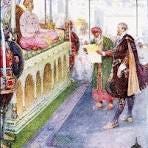
If we hark back a century, Sir Thomas Roe, the ambassador sent by James I to the Mughal court, is shown before the emperor Jahangir in 1614, at a time when the Mughal Empire was still at its richest and most powerful, wishing to be granted a patta, or trading rights for the East India Company.
What a huge difference in just one century!
Thanks for the restack :)