
ASHWATHTHAMA
The Being Cursed to Live Forever

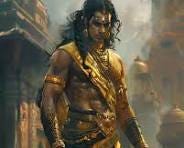
Ashwatthama Does Not Die
They say he still walks.
Not like a ghost; ghosts are merciful things. They fade, they soften, they become stories told to children before sleep. They belong to the past.
Ashwatthama does not. He belongs to the unfinished.
He committed the worst crime: a war is never just. Krishna, in many ways, tried to defer the war. But when the war became inevitable, he urged Arjuna to fight, because you do not arrive at a battlefield and discover morals. Dronacharya, the martial guru of both the Pandavas and the Kauravas, sided with the Kauravas, but Duryodhan accused him of being soft. So he unleashed a spate of weapons that were difficult to breach.
So they hatched a plot: Dronacharya was very devoted to his son, Ashwaththama, also a capable warrior. They made Yudhishtir, who was incapable of lying, say, ‘Ashwaththama is dead.’ Just then, Shankh Nad broke out, and Yudhishtir said, gently, under his breath, “Only an elephant."
Dronacharya was devastated, and he fell to his own death. Ashwaththama never forgot this treachery.
Condemned by Krishna to wander the earth until the end of the age, he was denied the one grace even the worst of men are granted: an ending. No funeral fire, no ashes carried away by a river, no forgetting. Only time and memory. And a wound that never closes.
We often misunderstand the nature of curses.
We think they are punishments imposed from outside: a god’s anger, a divine decree, a cosmic verdict. But the most enduring curses are not those given to us. They are those we continue.
Ashwatthama’s crime is well known. In a final act of vengeance, when the Kauravas had lost the battle, after the war had already devoured everything worth winning, he entered the sleeping camp of children and killed all the Pandava children. Not warriors in battle, not enemies in rage, but children, unarmed, unawake, unready and unguarded because nobody thought such a deed could be done.
It was not war. It was something darker. And for that, he was not killed. He was made to live. What does it mean to live forever?
Not in the fantasies we entertain: youth without end, endless sunsets, time to become everything we ever dreamed of. But this: To carry a moment that cannot be undone.
To walk through centuries with the same memory, unblurred by age, unsoftened by forgetting. To wake each day into the same night.
Perhaps immortality is not a gift because memory is not designed for it. We are built to forget, to heal, to let the edges of our pain wear down.
Ashwatthama is denied that erosion. He remembers as sharply now as he did then. But there is something else we do not say aloud: If his curse is to live until the end of the age, then why has the age not ended? Why does he still walk?
Perhaps because the act for which he was cursed has not ceased. Not in essence. Not in truth.
Somewhere, even now, a child cries out in the dark and is not heard in time. Somewhere, innocence is broken not by war, but by the deliberate cruelty of those who know exactly what they are doing. Somewhere, the boundary we pretend is sacred is crossed again. And again. And again.
We like to believe that we are far removed from the epics—that the world of the Mahabharata belongs to another age, filled with gods and warriors and moral absolutes.
But perhaps the epic never ended. Perhaps we are living inside it.
What if Ashwatthama does not walk because of a curse placed upon him?
What if he walks because we have not released him?
Because every time such an act repeats itself, we echo the night he cannot escape. We become its continuation.
His immortality, then, is not divine justice. It is human failure.
This is uncomfortable to sit with.
It is easier to relegate him to myth—to imagine him as a lone figure, wandering forests or temple ruins, his forehead bleeding, his eyes hollow, his story contained.
It is harder to consider that he might pass through crowded streets unnoticed.
That he might stand at the edge of a hospital corridor, or a police station, or a courtroom, listening. Watching. Not intervening—because he cannot.
Only witnessing.
And what does he see? Does he see progress? Or does he see repetition dressed in new language?
We have better laws, we tell ourselves. Better systems. Better awareness. And yet.
There are nights that would look familiar to him. There are silences he would recognise instantly.
There are justifications—quiet and insidious—that echo across millennia.
If this is so, then Ashwatthama’s curse is not only to live on but also to suffer.
It is to remember what we insist on forgetting.
And perhaps our burden—if we choose to accept it—is the opposite.
To remember what we would rather not see. Not as a spectacle. Not as passing outrage.
But as a question.
What does it mean to live in a world where such things are still possible?
And what does it mean to do nothing?
In the epic, Krishna does not simply punish. He reveals.
His curse is not only retribution; it is a mirror.
Ashwatthama is made to become the embodiment of a truth: that some actions do not end when they are committed. They ripple outward, inhabiting time itself.
We inherit them. We repeat them. Or, if we are willing, we interrupt them.
They say he still walks. Perhaps he does.
Or perhaps what walks is something less visible, but far more pervasive—a pattern, a shadow, a possibility within us.
The question is not whether Ashwatthama lives. The question is, why does he still need to?
Because we continue to have the filthy-rich, powerful paedophiles who masquerade as the messiah…!